

.png)
For years, social media marketing has revolved around one question: What should we post?
But some of the most interesting brands are starting somewhere else entirely: What can we create that people will want to post about?
Pop-ups. Installations. Brand stunts. Interactive spaces. Events people actually want to attend.
Experiential marketing is becoming increasingly important. In fact, recent industry data suggests that one in two companies planned to increase experiential marketing budgets between 2024 and 2026. (G2 Learn Hub)
At first, that can look like brands moving away from social media and back into the real world. But that's only half the story.
Some of the smartest experiential campaigns are being designed to work in two places at once: in real life and on social media.
A physical activation might reach hundreds or thousands of people in person. Give those people something surprising, funny, beautiful or culturally relevant enough to film, though and the audience becomes much bigger.
The experience becomes the content. And the people experiencing it become part of the distribution.
What is experiential marketing?
Experiential marketing is a marketing strategy built around giving people something they can actively experience rather than simply putting an advertisement in front of them.
That could mean:
- Pop-ups and brand activations
- Interactive experiences
- Installations
- Events
- Immersive spaces
- Public stunts
- Product experiences
Instead of telling someone what your brand is about, you give them an opportunity to interact with it. Think of the difference between seeing a photo of a concert and actually being there. One gives you information. The other gives you a memory.
In 2026, there's another important layer: That experience probably isn't staying offline.
Someone photographs it. Someone films it for TikTok. Someone posts it to their Instagram Story. Creators cover it. The brand captures its own footage. Other accounts react to it. Media publications pick it up.
One physical experience can suddenly produce a huge amount of digital content.
Experiential marketing isn't replacing social media
This is where the shift gets interesting. The renewed interest in real-world experiences can easily be interpreted as a reaction against digital marketing.
People are tired of screens. Brands want more authentic connections. Marketing is moving offline again.
There's certainly evidence of growing appetite for physical experiences and more selective digital attention. Recent coverage has pointed to consumers seeking more real-world interactions as digital life becomes increasingly saturated. (The Australian)
But that doesn't mean social media disappears from the equation. Quite the opposite.
The physical and digital sides of marketing are becoming more connected.
An activation can be designed for the people standing in front of it and the much larger audience who will eventually encounter it through a screen.
The experience becomes the content engine
One activation can potentially generate:
- Brand-owned photos and videos
- Behind-the-scenes content
- Attendee posts
- Creator content
- User-generated content
- Reactions and commentary
- PR coverage
- Recap content
- Short-form videos
- Follow-up social posts
That's a very different content model from sitting in a meeting and trying to brainstorm another 20 posts. And some recent campaigns show exactly what this looks like.
LEGO put F1 drivers behind the wheel of life-size LEGO cars
At the 2025 Miami Grand Prix, LEGO and Formula 1 created something that was almost impossible not to film. They built 10 fully drivable LEGO cars, representing every Formula 1 team on the grid, and put all 20 F1 drivers into them for the Drivers' Parade.
These weren't small props, either. Each vehicle was made from nearly 400,000 LEGO bricks, weighed around 1,500 kg and could reach speeds of 20 km/h. (LEGO)
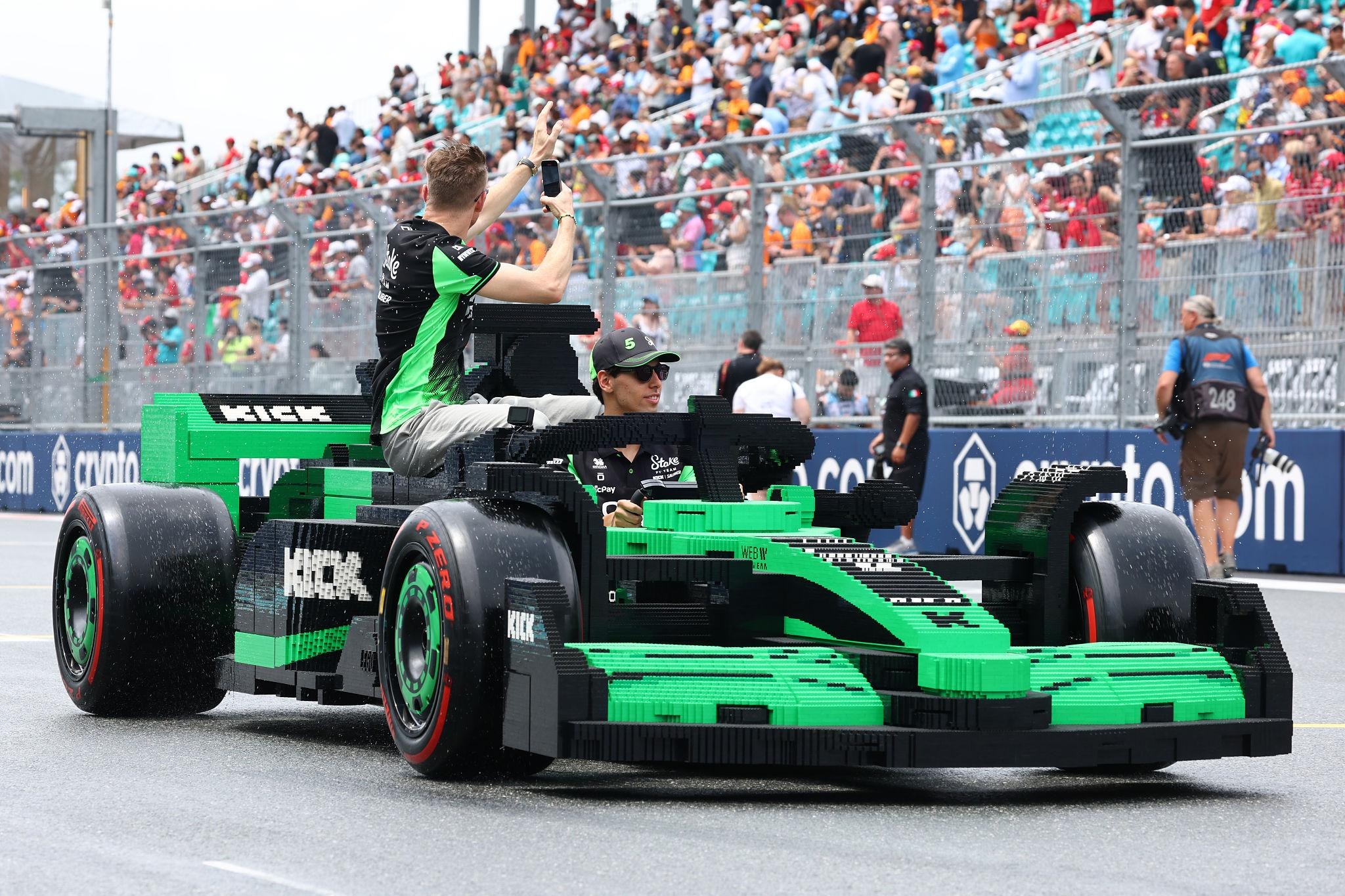
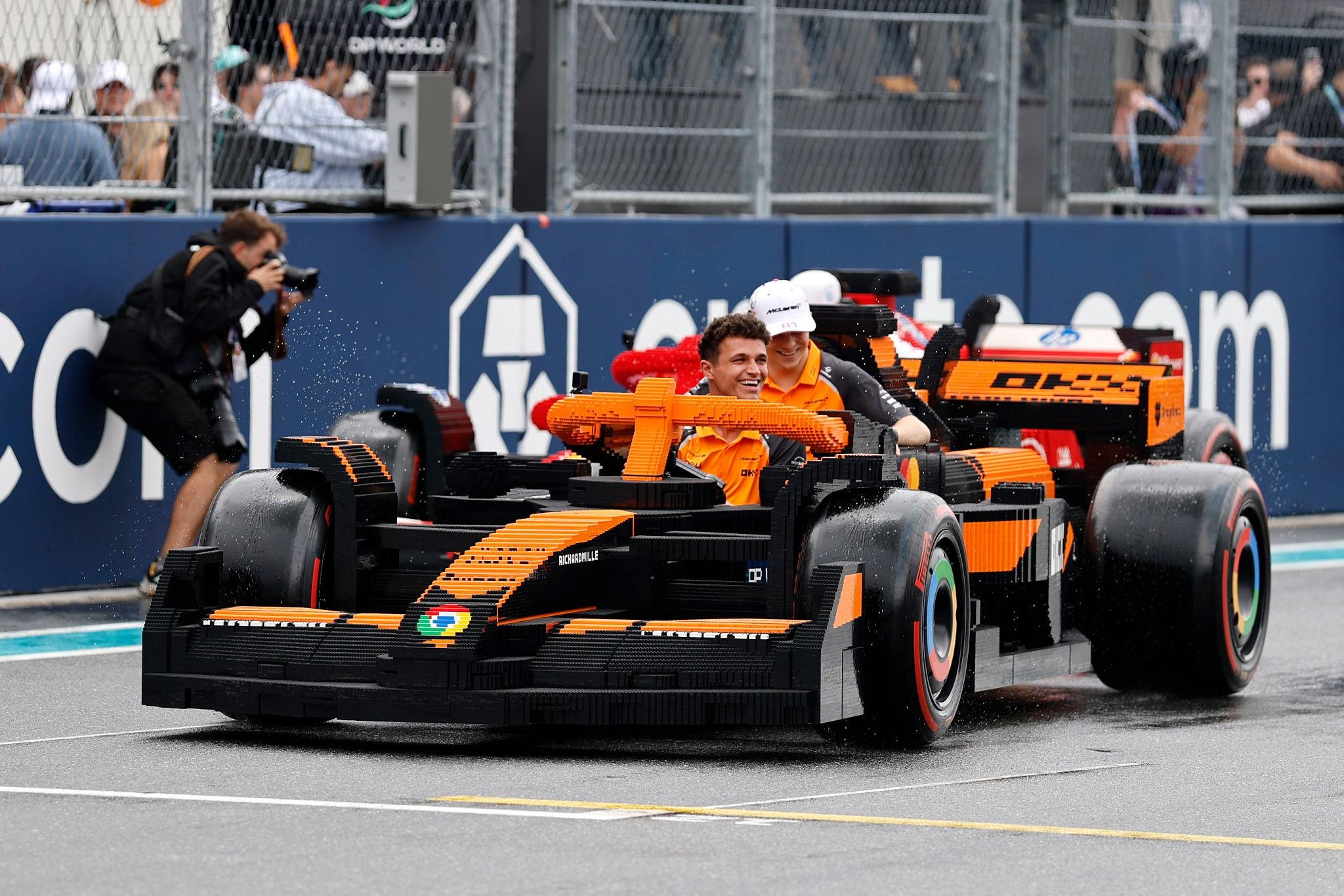
From a content perspective, the idea is almost perfect because it barely needs explaining. You see Formula 1 drivers driving giant LEGO cars around a racetrack and immediately understand why someone would pull out their phone. The physical experience is the hook.
And LEGO understood the content opportunity too: its official announcement provided downloadable stills and video assets from the activation. (LEGO)
The lesson: Before asking how you'll promote an activation, ask whether the activation itself is interesting enough to become the promotion.
Drake turned an album release date into something people had to uncover
In April 2026, a giant structure made from blocks of ice appeared in a Toronto parking lot. Somewhere inside was the release date for Drake's upcoming album, Iceman.
The idea was simple: the answer would be revealed when the ice melted.
Fans had other plans.
People started attacking the ice with pickaxes and even their bare hands, trying to uncover what was hidden inside. The following day, Twitch streamer Kishka found the release date, May 15, inside an outer block. (Pitchfork)
The stunt eventually attracted so much activity that Toronto fire crews intervened over safety concerns and used warm water on the structure. (Pitchfork)
This is where the distinction between offline marketing and online marketing starts to fall apart. The installation existed physically in Toronto. But you didn't need to be there to follow the story. There was a mystery. There was a countdown. People were trying to solve it. The situation kept changing. And every new development gave people another reason to film, stream, post and talk about it.
Tinder turned "emotional baggage" into an actual truck
Sometimes experiential marketing doesn't need a huge technological installation. It just needs a good joke. In Mumbai, Tinder took one of dating's most familiar phrases, emotional baggage, and made it physical.
Its bright pink "Ex-Press Disposal Truck" invited people to dispose of reminders of previous relationships, with messaging on the vehicle including "Caution: Emotional Baggage Inside." (Hindustan Times)
The concept works because you understand it almost immediately.
Dating. Exes. Emotional baggage. Tinder.
The marketing message becomes a physical object.
And because the truck itself is funny and visually unusual, it gives people something to photograph and talk about without simply asking them to share an advertisement.
The lesson: Look at the phrases, jokes and behaviors people already associate with your industry. Then ask what would happen if you made one of them real.
IKEA made a London icon unmistakably IKEA
When IKEA opened its Oxford Street store in London in May 2025, one of the visuals surrounding the launch combined two instantly recognizable things: a classic London black cab and IKEA furniture.
The taxi appeared with an IKEA sofa strapped to its roof, an extremely simple image that communicated the idea without requiring much explanation. IKEA included the image in its official coverage of the store opening. (IKEA)
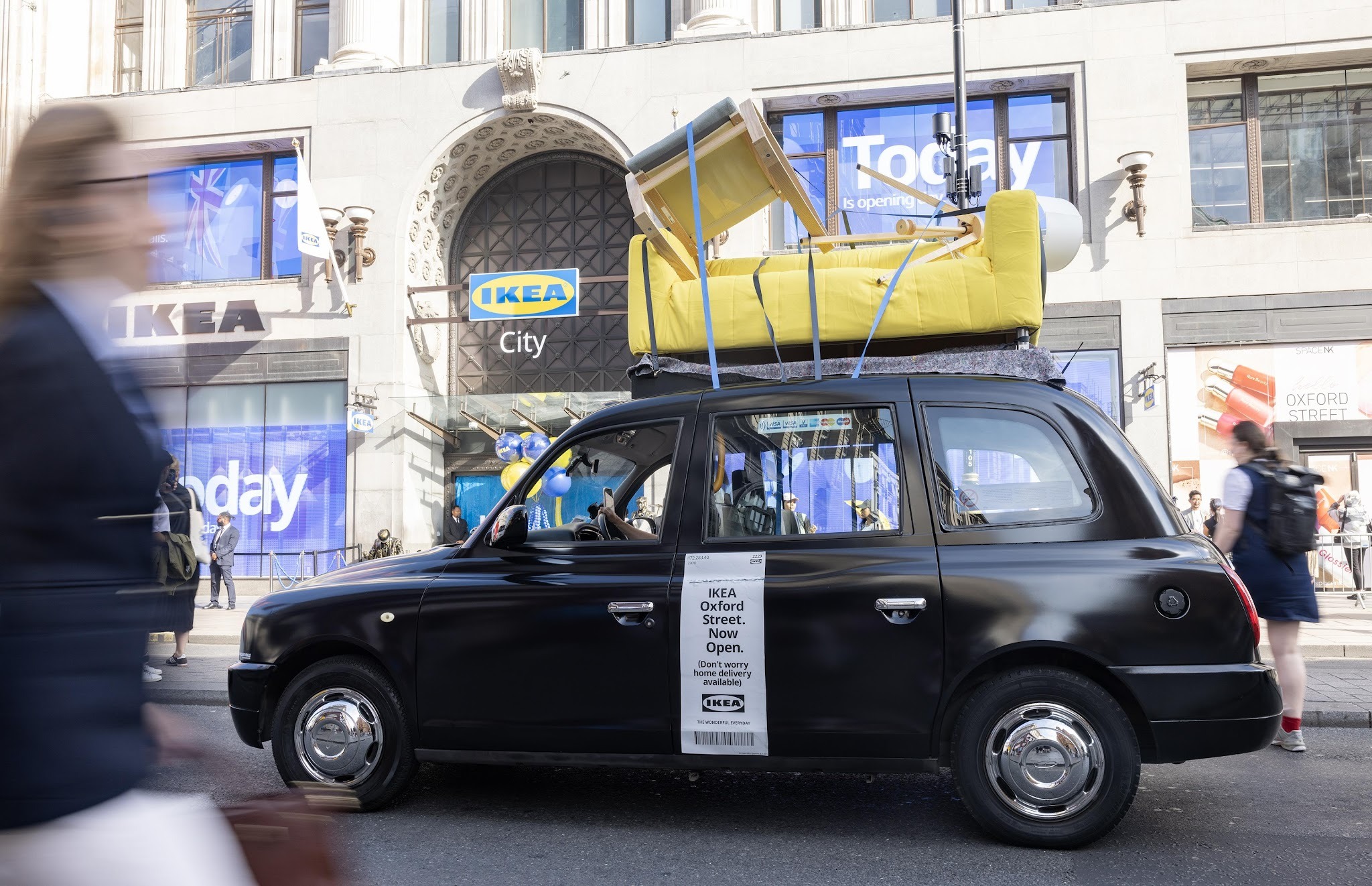
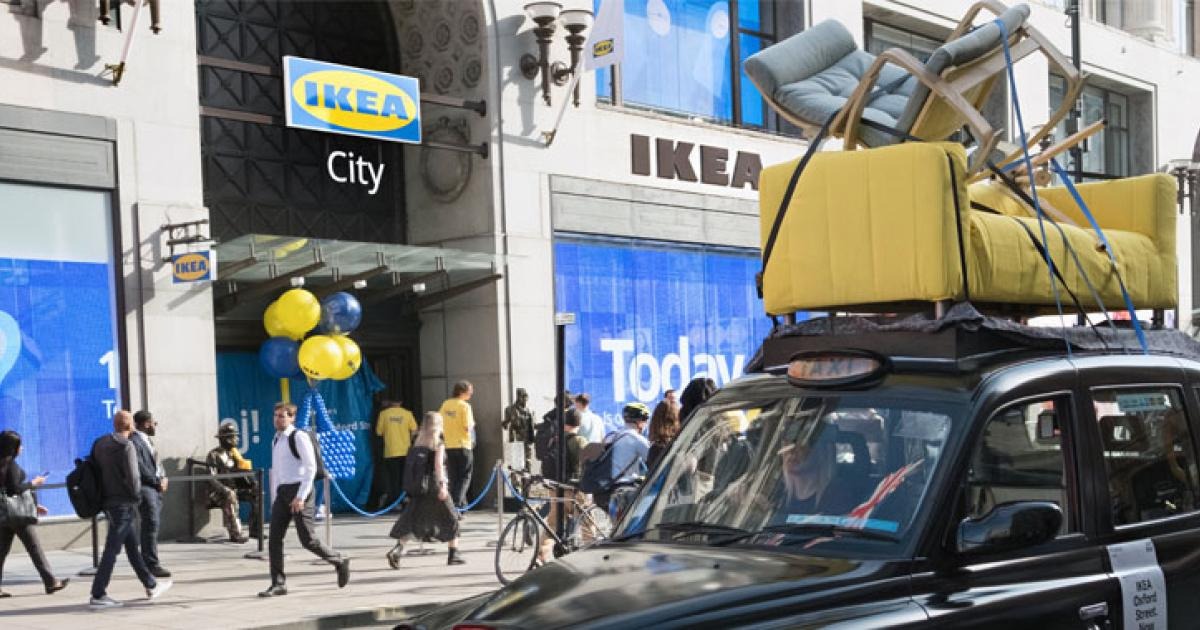
That's useful because experiential marketing can sometimes become synonymous with enormous budgets and elaborate installations.
It doesn't have to be. The interesting part here is the simplicity. Take something everyone recognizes. Change it in a way they don't expect. Make the brand connection obvious.
The lesson: You don't necessarily need to build something completely new. Sometimes transforming something familiar is enough to make people look twice.
What these campaigns have in common
A LEGO F1 car, a melting block of ice, a breakup truck and a furniture-loaded taxi don't have much in common visually.
But from a marketing perspective, the mechanics are remarkably similar.
They create something that is:
- Easy to understand
- Visually distinctive
- Connected to the brand or product
- Interesting without a long explanation
- Worth photographing or filming
- Easy to tell someone else about
Most importantly, the experience doesn't end when someone leaves.
It travels.
The best experiential marketing gives people a reason to post
This leads to one of the biggest opportunities for brands.
Traditional advertising usually works like this:
Create content → pay for distribution → audience sees content
Experiential marketing can add another loop:
Create experience → people participate → people create content → their audiences discover the brand
Of course, not every attendee is suddenly an influencer and not every activation will go viral. But the fundamental behavior is powerful. People already document what they do.
Where they went. What they discovered. What surprised them. What their friends missed.
Why this matters even more in the age of AI content
There's another reason this approach feels particularly relevant in 2026. Creating digital content has never been easier. AI can help brands produce copy, graphics, videos, variations and ideas faster than before. For smaller marketing teams especially, that's incredibly useful.
But easier production also means more content competing for the same attention.
Simply producing another polished image isn't automatically remarkable. A physical experience introduces something that is much harder to manufacture through another content prompt:
Something actually happened.
There were people there. They interacted with it. They reacted. They filmed it from different perspectives. The digital content is evidence of a real moment.
That's why the rise of AI and the rise of experiential marketing don't have to contradict each other.
AI can make producing and repurposing marketing content easier.
Experiences can give brands something genuinely interesting to make that content about.
You don't need a LEGO-sized budget
This is usually the point where smaller brands switch off.
Great. We'll just build ten Formula 1 cars.
But the useful takeaway is to copy the thinking.
Ask:
- What would make someone stop and take a photo?
- Could we turn our product benefit into something physical?
- Is there an industry phrase we could make literal?
- What would make our next launch feel like an event?
- Could customers participate rather than simply watch?
- What would someone genuinely send to a friend?
- Could we create a reveal?
- Could something change over time?
- Is there an ordinary object we could transform?
- What would make someone say, "You need to see this"?
The answer doesn't have to be a giant installation. It might be a clever sign outside your store.
Design for two audiences
When planning experiential marketing in 2026, it helps to think about two audiences simultaneously.
Audience 1: the people who are actually there.
- What do they get to experience?
- What can they touch, discover, participate in or remember?
- Why would they tell someone about it afterward?
Audience 2: everyone who will see it through a screen.
- Can they understand what's happening quickly?
- Is there a strong visual?
- Is there a story?
- Is there an unexpected moment?
- Would they send it to someone?
- Would they watch until the reveal?
A strong concept works for both.
Create something worth experiencing. Make it worth sharing. Then turn that one experience into content that travels far beyond the people who were actually there.
What’s Included
Starter
.png)
Pro