
How to Improve AI Accuracy: Lessons from MIT Research on Better Reasoning

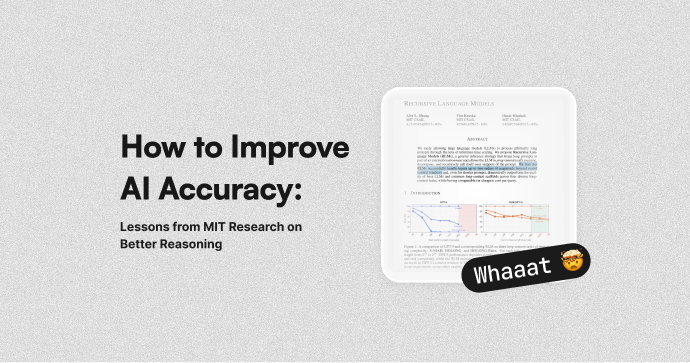
Most people searching for better ChatGPT prompts are trying to fix the same problem:
AI sounds confident…but the answers aren’t always right.
New research from MIT (https://arxiv.org/pdf/2512.24601) shows that the issue isn’t intelligence or knowledge. It’s how AI is forced to make decisions.
The study reports up to 2× performance improvements on certain tasks when AI systems are designed to delay commitment, explore alternatives, and evaluate their own reasoning.
Let’s explore how AI products should be architected going forward and how we can mimic this today with prompting.
Why AI often gets things wrong (even when it sounds right)
Most AI tools work like this:
- You ask a question
- The model generates an answer
- The answer sounds confident
The problem: The model is forced to commit too early.
When there’s uncertainty, missing information, or multiple valid paths, AI still has to pick one. That’s where hallucinations and bad advice come from: not lack of intelligence, but premature commitment.
MIT researchers focused on fixing exactly this failure mode.
The core insight
The most important lesson from the paper is surprisingly simple: AI performs much better when it is not forced to decide on the first try.
Instead of producing one answer, the best-performing systems:
- explore multiple possible solutions
- evaluate those solutions separately
- repeat the process if confidence is low
- only commit when the system is reasonably sure
This mirrors how humans make good decisions: we think, review, reconsider…then decide.
Why this improves AI performance so much
The performance gain does not come from:
- longer prompts
- more tokens
- more detailed instructions
It comes from separating generation, evaluation and commitment into distinct inference steps.
Traditional AI workflows collapse everything into one step:
think → answer → done
The research shows better results with:
generate → review → repeat if needed → decide
This reduces:
- confident but wrong answers
- overgeneralized advice
- false certainty in complex situations
How we can mimic this today with better prompting
Even though the research focuses on system architecture, you can approximate the behavior as a user by changing how you ask questions.
The key rule
Don’t ask for “the best answer” first.
Instead, ask AI to explore before deciding.
Example prompt structure
Help me make a decision.
1. List 3–5 possible approaches.
2. For each approach:
– explain when it works
– explain when it fails
3. Highlight uncertainties or missing information.
4. Only then recommend an option, or say you cannot decide yet.
This simple structure:
- prevents premature answers
- forces comparison
- allows uncertainty to surface
It’s the closest user-level version of what the research shows works best.
Why context is no longer the main bottleneck
A subtle but important insight from the research:
Better performance doesn’t come from stuffing more information into one prompt.
It comes from handling reasoning across multiple passes.
Instead of relying on one large context window, the system:
- runs several focused reasoning steps
- evaluates results separately
- passes only what matters forward
This reduces dependence on a single large context window and allows reasoning depth to scale more reliably across multiple inference passes.
What this means for AI product builders
If you’re building AI products (or systems like Whaaat AI), the implication is clear:
Don’t build chatbots. Build decision systems.
Practically, this means:
- separating idea generation from evaluation
- allowing uncertainty as a valid outcome
- looping only when problems are complex
- committing only after internal review
The biggest gains don’t come from smarter models, they come from better reasoning orchestration.
The real takeaway
The MIT research confirms something fundamental:
AI doesn’t fail because it lacks intelligence. It fails because it’s pushed to decide too quickly.
When AI is allowed to:
- Explore
- Verify
- Reconsider
- and delay commitment
Performance improves dramatically. That’s true for machines, as well as for us humans.
What’s Included
Starter
.png)
Pro
Starter
Pro