

.png)
On LinkedIn today, content isn’t failing because it’s “bad.” It’s failing because it’s misplaced.
The same idea can:
- get ignored
- start conversations
- or position you as an expert
…depending entirely on the format.
Not better content but better placement.
What changed on LinkedIn (and why this matters now)
A year ago, you could post almost anything and get reach. Today?
Everyone can generate content in seconds.
So now there’s more noise than ever.
Which means:
- Surface-level posts don’t hold attention anymore
- Generic advice gets ignored
- “Value posts” all sound the same
If your content doesn’t make someone stop, it dies.
That’s why format matters more than ever.
LinkedIn Posts: Built for attention and conversation
Posts are your entry point. They’re not meant to explain everything.
They’re meant to make people care enough to engage.
A strong post does one thing well: It makes someone stop scrolling
That’s it.
From there, it should:
- trigger a reaction
- start a conversation
- or lead to a message
What most people get wrong: They try to do too much in one post.
They:
- over-explain
- add too many ideas
- turn it into a mini article
And it kills performance.
What actually works in posts now
- One clear idea
- One strong angle
- Something only you can say
Not: “5 tips for…” “Here’s a framework…” “Everyone should…”
That’s exactly the content AI floods LinkedIn with now.
Instead: share what you’ve seen, what worked, what failed or what surprised you.
That’s what people engage with.
LinkedIn Articles: Built for depth and authority
Articles play a completely different role. They’re not about stopping the scroll.
They’re about:
- building trust
- showing expertise
- being referenced later
While posts disappear in the feed…
Articles:
- get indexed
- get cited
- get reused in AI answers
- build long-term visibility
This is where you go deeper.
What works in articles
- clear thinking
- structured insights
- real examples
- actual explanations
Not: vague ideas, generic motivation or recycled advice.
Articles reward depth. And right now, depth is rare.
The simple way to decide (this is all you need)
Before you create anything, ask: What is this idea supposed to do?
Use a POST if:
- you want attention
- you want engagement
- you want conversations
- you want people to react now
Use an ARTICLE if:
- you want authority
- you want to explain something properly
- you want long-term visibility
- you want to be found later (including AI search)
Most people use posts wrong (and expect them to do everything)
This is where things break.
People expect one post to:
- go viral
- explain everything
- generate leads
- build authority
That’s not how it works anymore.
Posts are the start.
Not the whole strategy.
A better way: One idea → two formats
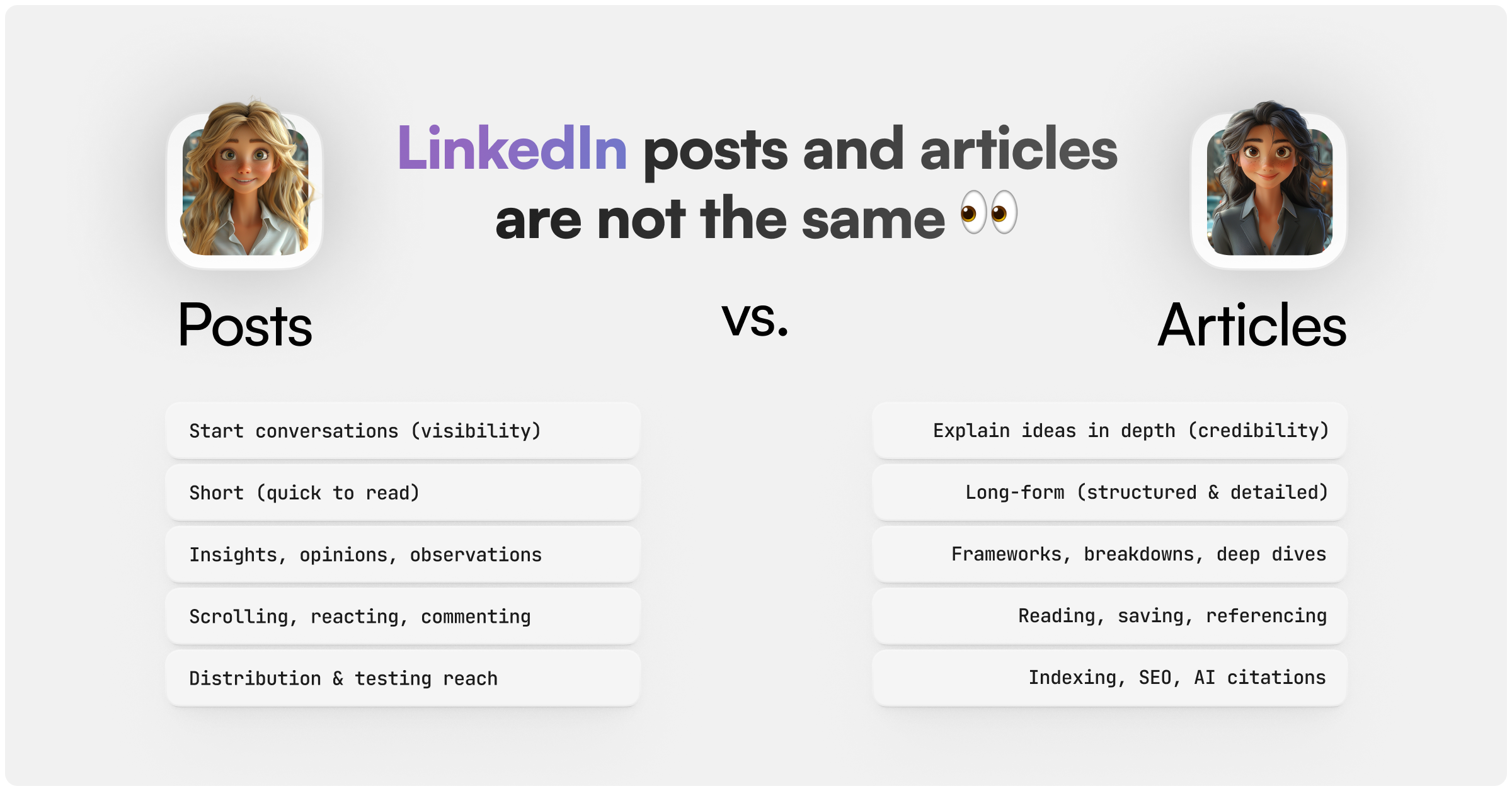
Instead of choosing between post or article…Use both.
Here’s how it actually works:
Step 1: Start with the post
Take your core idea and compress it.
Make it sharp.
Make it clear.
Make it scroll-stopping.
This is where our agent Lin shines, turning your idea into a post people actually engage with (or helping you with ideas if you need support in getting started).
Step 2: Expand into an article
Take the same idea and go deeper. Explain:
- the context
- the reasoning
- the examples
This is where Lina comes in, writing your LinkedIn articles while following best practices and making sure you have a valuable content piece.
The real LinkedIn strategy in 2026
If you strip everything back, it’s this:
- Posts: get attention
- Conversations: build relationships
- Articles: build authority
Most people only do the first.
That’s why they plateau.
Final takeaway
Stop asking: “Post or article?”
Start asking: “What is this content supposed to do?”
Because once that’s clear…The format becomes obvious.
What’s Included
Starter
.png)
Pro
Starter
Pro