

If you’ve ever searched:
- “best marketing prompts”
- “LinkedIn post prompt”
- “AI prompts for content marketing”
- “ChatGPT prompts for social media”
You’re not alone.
Because everyone hits the same wall:
👉 AI works… but only if you prompt it well.
And that’s where things get frustrating.
What “good marketing prompts” actually look like (in reality)
Most guides will tell you something like: “Just use better prompts.”
But to get a good LinkedIn post, you need to include:
- your target audience
- your tone of voice
- your goal (engagement? leads? authority?)
- structure (hook, body, CTA)
- platform best practices
- examples of what “good” looks like
So your “simple prompt” becomes this whole system:
- Task
- Context
- References
- Rules
- Alignment
- Iteration
At that point…
👉 you’re not writing a prompt anymore
👉 you’re building a mini marketing workflow
Why most marketing prompts don’t actually work
You’ve probably experienced this: You find a “top 50 prompts for marketing” post…
You copy one…And the output is just… average.
Why?
Because: The same prompt + different context = completely different results
Or as someone put it perfectly: “Most people don’t have a prompting problem. They have a clarity problem.”
True. But even with clarity…You still need to translate that into the right prompt structure.
And that’s where time disappears.
The hidden cost of using marketing prompts
Let’s break it down. Every time you use AI for marketing, you:
- rewrite or tweak prompts
- explain your audience again
- adjust tone manually
- fix formatting
- retry because something feels off
That’s not saving time. That’s trial & error disguised as productivity.
What people actually want when they search “marketing prompts”
NOT more templates! They want:
- something that just works
- outputs that already fit the platform
- content that sounds like them
- no back-and-forth tweaking
In other words:
👉 they don’t want prompts
👉 they want results
This is where Whaaat AI flips the model
Instead of giving you better prompts…We removed the need for them.
What happens when you say: “I need a LinkedIn post”
Inside Whaaat AI, that one sentence triggers a full system:
- Lin already knows how LinkedIn content works
- your brand voice + audience are pre-loaded
- the structure (hook, flow, CTA) is built-in
- the best LLM is running in the background
- formatting and optimization happen
You don’t need to write detailed prompts or explain context and structure every time. It’s all handled!
From “prompt engineering” → to “just say what you need”
Here’s the shift:
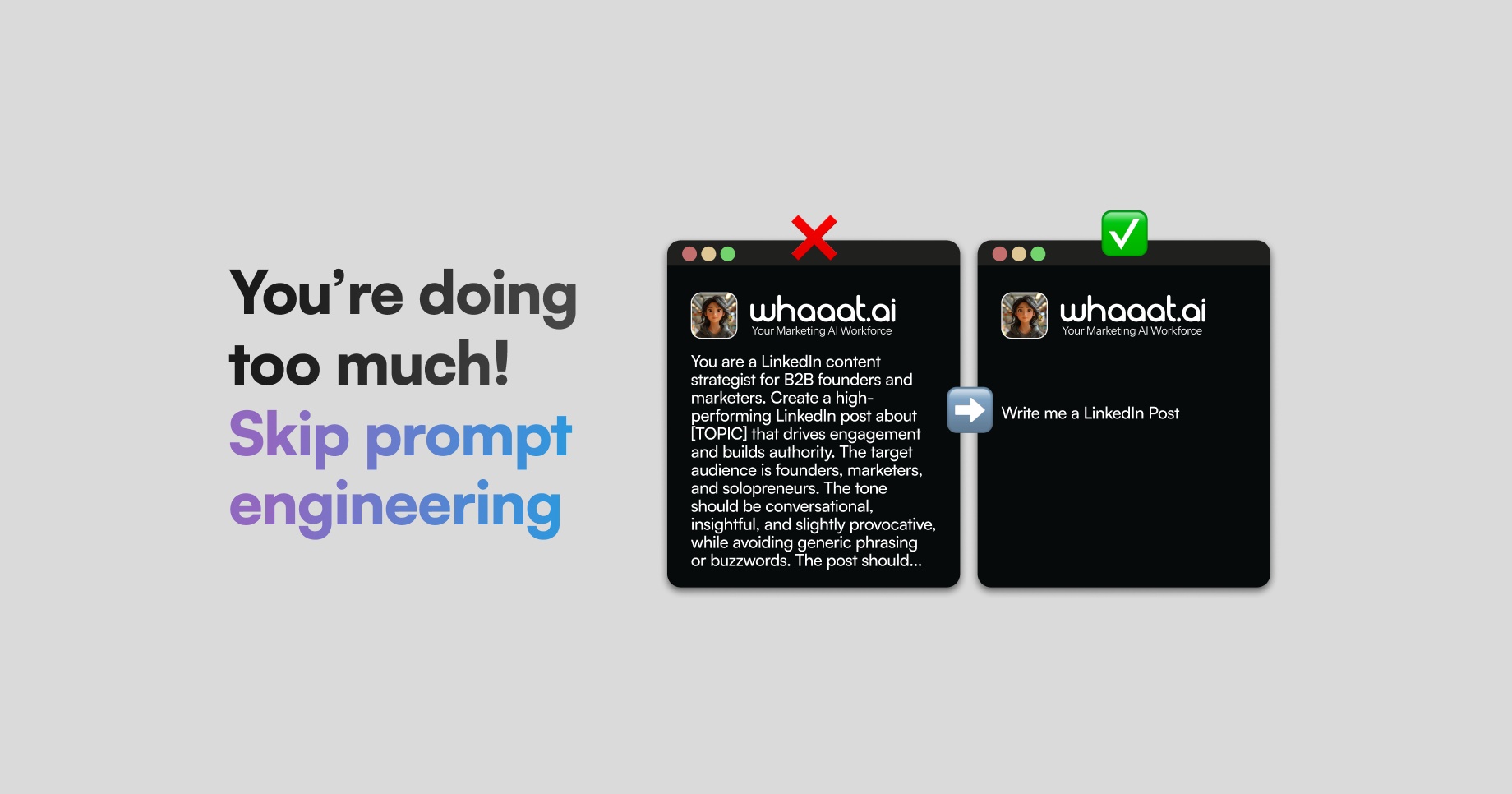
Before: “Act as a LinkedIn expert. Write a post for [audience] with a strong hook, storytelling structure, engaging tone…”
Now: “I need a LinkedIn post about [topic]”
That’s it.
And it doesn’t stop at one post
Marketing isn’t one output. It’s: LinkedIn, Instagram, TikTok Blog, Newsletter, X and so much more! Instead of writing separate prompts for each…
You just say: “@Lin @Ines @Bob, turn this into content for each platform”
And get everything in one go.
Because the agents already know:
- their platform
- your context
- how to adapt the message
This is exactly how multi-platform content gets created without rewriting everything manually
The bottom line
You can keep searching for:
- better marketing prompts
- longer prompt templates
- “ultimate prompt frameworks”
Or…you can skip the entire layer.
One simple test
Next time you open an AI tool, ask: “How much do I need to explain before I get something usable?” If the answer is more than one sentence…you’re still doing prompt engineering.
Or you could just say: “I need a LinkedIn post.”
And move on.